Every four years, populations across the world unite for one of the most anticipated sporting events: The Winter Olympics. Countless sports, from hockey, to bobsledding, to curling garner anticipation and patriotic excitement from millions of viewers. And yet, out of all of the events, one stands out as the most artistic and arguably, the most emotional as well. Of course, this would be none other than figure skating. This year, Team USA faced some incredible ups and downs at the Milano-Cortina 2026 Winter Olympics Games.
The first event to take place was the team event, which combines the short program and free skate of men’s singles, women’s singles, pairs, and ice dancing for combined points that go towards the nation’s team as a whole, instead of individual skaters. Points are earned based on the standings in each individual segment and at the end of all the segments, the points are totaled and a winner is announced.
This year, the United States earned this victory with 69 points, securing gold in the figure skating team event final standings. Mostly thanks to Ilia Malinin, who delivered an impressive 200.03 pointed free skate. Typically, high scoring athletes earn between 150-170, with medalists often averaging 170-190, so this was a very strong start. However, while this win was very important for Team USA, some question whether it impacted some of the skaters later on for their individual events.
Almost immediately after the team events were the individual events, starting with the ice dancing qualifiers (short program) and then the men’s singles qualifiers (short program). During the men’s singles first day, on February 10, Ilia Malinin quickly rose to first place with 108.16 points, delivering a beautiful performance to “The Lost Crown”.
This wasn’t unsurprising since Malinin, playfully dubbed the “Quad God”, is a two-time figure skating world champion, four-time national champion, and the only person in the world who has successfully completed the quadruple axel (hence the nickname), an incredible 4.5 turns in the air while going into the jump forwards and ending backwards, in competition! Malinin also holds the world record for most points in a free skate — 238.24 points. If you were to ask practically anyone who they thought would win gold, they likely would have said “Ilia.” Other favorites like Yuma Kagiyama of Japan and Adam Siao Him Fa of France were expected to be top contenders for silver and bronze.
But then, something unexpected happened. In the final round, Ilia Malinin fell twice, aborted completing a quad axel by changing it into a single axel, and popped a quad loop, turning it into a double. All of this caused him to drop to a shocking 8th place. Both Yuma Kagiyama and Adam Siao Him Fa also failed to perform as well as anticipated, though Yuma was able to pull out a silver medal in the end. The gold medalist ended up being Kazakhstan’s “underdog” Mikhail Shaidorov. And, even though Malinin was facing a devastating loss in his career, he immediately went over to Shaidorov in an act of friendship and good sportsmanship to congratulate him on his win, telling him that he deserved it.
Malinin told interviewers that he attributes some of this loss to the immense pressure of expectations for him to do well. He also made comments about “vile online hatred” affecting performers and athletes. Malinin did say, though, that he believes he has learned from this experience and will take this new knowledge with him in his future. He also said that several well-known athletes, such as Tom Brady, Stephen Curry, and Simone Biles, even reached out to him with support, showing that all of Malinin’s fans still hold immense love and regard for him.
On a happier note for the United States, Alysa Liu won gold for women’s singles, delivering a near-perfect free skate performance. When she was younger, Liu became the youngest U.S. champion at the age of thirteen and was the first American woman to land a quad jump. Then, she retired from figure skating at just sixteen years old. She eventually rediscovered a passion for the sport, returning and making a comeback by winning the 2025 World Championships. Now, she focuses more on the happiness and enjoyment of the sport, rather than the competitive pressure that many skaters, like Malinin, seem to suffer from.
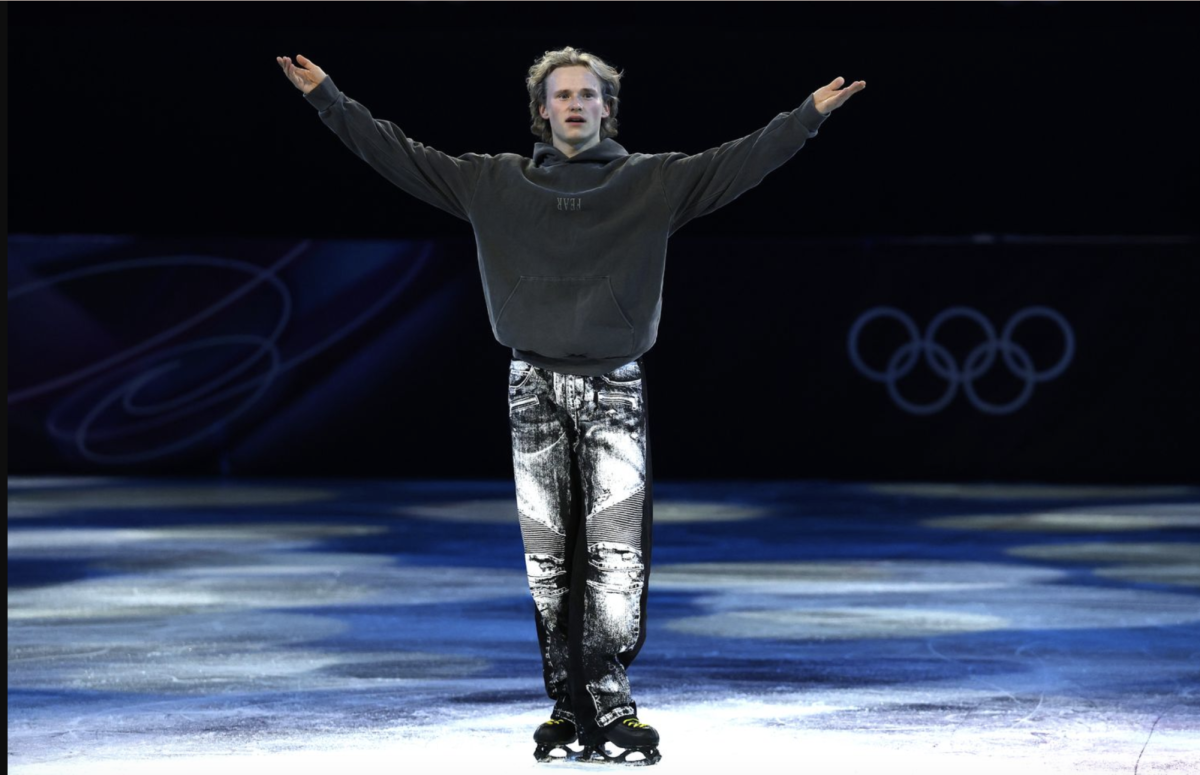
At the exhibition gala after the competitive events finished, Malinin skated to an emotional program using NF’s song “Fear” to highlight the impact of social media on mental health, even relating it to his own loss in the Winter Olympics. His powerful routine also showed viewers that he is continuing to put effort into his skating and that his loss does not define him.
Overall, this year’s Winter Olympics showed figure skating viewers a surprising amount of twists and turns, with ecstatic victories and tragic losses, supporting a huge resurgence of fans and its increasing global popularity.