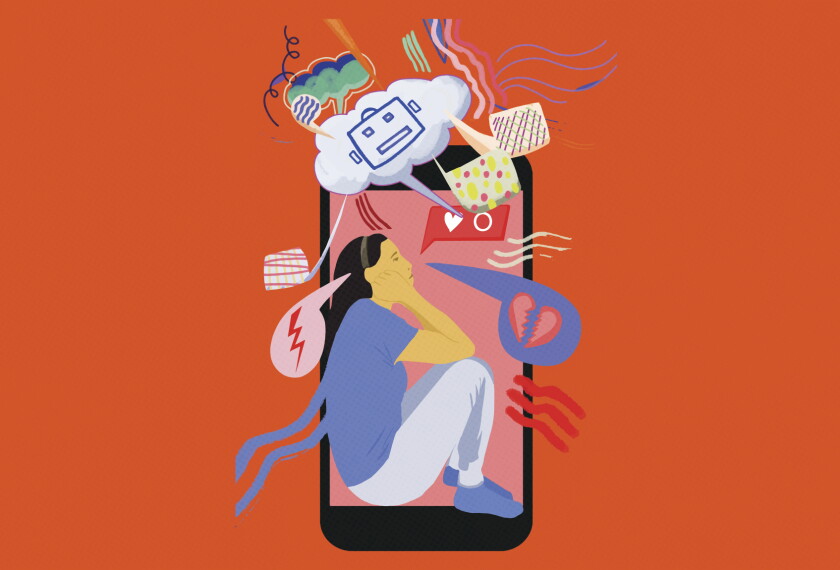
It’s undeniable that social media has taken over countless aspects of our lives. No matter the distance, in today’s digital age, all you need to do to contact someone is pick up your phone, open social media, and send a message. Plus, in that same app you can find some entertainment along the way. Within seconds, you can pull up a movie, TV show, or TikTok of your choice. It’s simple. Although this sudden availability of communication and entertainment is very convenient, it comes at a cost. Most notably, in my opinion, is the productivity of students.
Social media is designed to flood dopamine into your brain. Having such open access to this neurotransmitter that creates feelings of pleasure causes us to prioritize attaining this feeling over getting work done. While finishing work and being productive can also create feelings of pleasure, it takes much longer to achieve this high than the instant gratification that comes with the click of a button on a phone. Let’s be real: would you rather spend hours studying to feel rewarded, or achieve that feeling by using social media within seconds? This phenomenon is exactly why I believe we tend to gravitate towards using our phones over studying for our next test.
Other than just choosing to use it over opening a textbook, social media also impacts our attention spans. It alters our brains to crave short-term, rapid satisfaction, lowering tolerance for long-term tasks such as studying. Think about it. How many times have you found yourself putting down your textbook to take a 10-minute scroll break? I know the answer to the question for me is many times. Not only does studying take longer because of these breaks, but it also becomes much less productive.. I notice that I often wish I had studied more for tests, but chose not to because I’d rather be scrolling instead. And despite noticing this pattern over and over again, nothing changes. It’s almost like an addiction.
Another Hunterdon Central junior, Olivia Piazza, spoke on how FOMO (fear of missing out) impacts her studying habits. “I think it makes it a lot harder to focus because you’ll always feel like you’re gonna miss something, kind of like FOMO. And you’re always like ‘Oh, maybe I should check my phone’ or ‘Oh, maybe something happened on social media’, something like that”. Having 24/7 access to current events occurring locally, nationally, or even globally makes it difficult to shut off social media. As Olivia said, many students, such as her and myself, always worry that the few hours you’re offline studying, something big is going to happen and you’re going to miss it. Olivia says that in order to avoid this, she has to put her phone in a separate room when studying.
Despite all the negative impacts social media has on studying, there is another perspective. Sofia Lopez, another Hunterdon Central junior, finds that many students, such as herself, use social media as a tool to study. She mentions how there are many content creators on YouTube, Instagram, and TikTok who post study tips, free resources, or informational videos about various topics, providing an easily accessible and quick way to study. I think a great example of these creators would be Heimler’s History, a well-known YouTube channel dedicated to teaching students about history, specifically AP course content (AP European History, AP World History, AP U.S. History, etc.). He even offers exclusive online study materials that students can pay for to prepare for their AP exams. Other than YouTube videos, there are also many content creators who post short videos, in the form of TikToks or Instagram reels, offering study material for students who prefer short-term content. However, I find it unlikely that most students predominately use social media for academic purposes rather than for entertainment.
In conclusion, I firmly believe that social media acts as a huge barrier to productive studying. It induces feelings of FOMO, inclining students to be glued to their phones, and provides dopamine highs that aren’t as easily achieved by efficient studying. With shortening attention spans, students such as myself find it difficult to study for more than short increments of time without picking up our phones and checking social media. However, it could be used effectively if students invest even a small amount of time into checking out educational content-creators on these platforms to help assist with their academics.