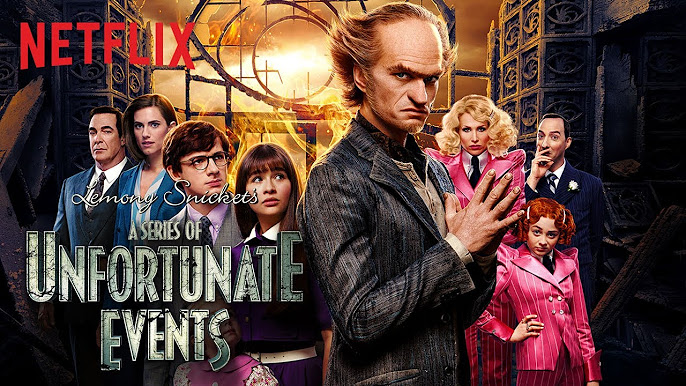
Is it luck, or is it just coincidence? Although many don’t label themselves as superstitious, most of us follow traditions to summon luck. Whether it be wearing a certain lucky item, knocking on wood, crossing our fingers, or spotting a lady bug on our clothes, we find ways to manifest a little positivity and hope in our lives. Following three orphans, the Netflix original show A Series of Unfortunate Events uses the concept of luck as a lens and explores its role in interpretation, in preparation, and in destiny, reflecting much of our conflicting ideas in society. A Series of Unfortunate Events blurs the line between luck and reality in a way that leaves viewers reflecting on their own beliefs.
Episode one begins with the Baudelaire children–Klaus, Violet, and Sunny–spending a relaxing day on the beach. Mr. Poe, a banker, approaches them abruptly, breaking the news of their parents’ death. The next day, Mr. Poe takes them to their new guardian, Count Olaf. Immediately, viewers are introduced to the idea that the Baudelaire children have terrible luck. The abrupt passing of their parents seems bad enough, especially considering it was in a terrible fire, meaning they lost their home as well; but this is only the beginning of their misfortune. Soon after meeting Count Olaf, the Baudelaire children realize that he has ulterior motives other than being their guardian. Count Olaf has his eyes on the family fortune, which Violet can’t inherit because she isn’t yet 18. The series follows the children as they cycle through new homes and guardians, all of which are interrupted by Count Olaf still looking to take the fortune. Every time the cycle seemingly ends, and their bad luck finally ran out, Count Olaf brings new chaos to their lives. Many attribute this to the idea that the Baudelaires are just extremely unlucky–which is especially supported by the word “Unfortunate” in the show’s title. Time after time, Count Olaf always seems to have a plan to destroy the lives they try to build in their new homes.
The children aren’t always unlucky, though. In every situation, even life or death, the Baudelaires make it out using their wits and talents. Violet, the eldest daughter, makes gadgets that allow them to escape dangerous situations or traps. Klaus, the only son, has an abundance of knowledge that allows him to read complex texts and pull life-saving information from memory. And Sunny, the baby, has razor sharp teeth that allow her to bite her way out of situations. These skills allowed them to escape the grasp of Count Olaf every time–which some people attribute to good fortune.
This idea of the Baudelaires’ talents may spark some conflict on the role of luck in their story. Do they escape because they are lucky, or are they “lucky” because they’re prepared? Both sides offer great arguments. Some may argue that their near-death experiences and last-minute escapes from death are just coincidence or destiny, while others attribute it to their preparation to use their talents. Would they have escaped the perilous people and places that were supposed to be their new homes if it weren’t for their abilities? Whether it be Sunny’s poisoning in The Grim Grotto or the jail cell in The Vile Village, it seems we will never receive a definitive answer.
This lack of an answer may lead viewers to question their interpretation of luck. Do we use luck as a lens to view things as predestined or fated, such as the death of the Baudelaire parents? Were the parents always destined to die, leaving them in their treacherous cycle with Count Olaf? Or do we turn away from luck and instead credit outcomes to preparation or coincidence, such as the children’s natural talents for escape? It appears the show blurs the lines to reflect how we use luck in reality. Think of all the times you have used luck as a way to explain a hardship in your life. Have you ever failed a test because you weren’t wearing your lucky socks? Or, were you just unprepared? Did you get offered that job you really wanted because you knocked on wood? Or were you just well qualified? A Series of Unfortunate Events leads viewers to question their own interpretation of luck, and how we utilize it to understand our own lives and experiences. It suggests that luck may not be something we actually have, but something we use to comprehend our lives. So, if you ever find yourself sitting down and watching this show, try to consider how the characters’ “unlucky” and “lucky” situations reflect how you interpret your own.