All that is old can be made new again. First being stitched in the deserts of ancient Egypt before adorning the drawing rooms of Victorian England, needlepoint is no exception to this rule. For most, one’s experiences with needlepoint are confined to memories of a wall hanging or an intricately stitched pillow displayed in their grandmother’s house, always welcome and admired, but considered a relic of the past. However, contrary to what some may think, the tapestry of needlepoint’s existence won’t end with the Baby Boomers, as the Millennials have taken up the needle and are making their own mark in the world of stitches, breathing new life into the artform in the process.
Like many other crafts, needlepoint became popular in 2020 during the COVID-19 quarantine that left many trapped in their homes with little to entertain themselves. In such a desolate time, needlepointing served as a relaxing way of filling the long hours, disconnecting from the internet, and expressing oneself creatively, all of which many struggle to achieve in today’s fast-paced world of technology. The majority of these new needlepointers discovered the hobby through TikTok, as the app served as a platform for communicating with other needleworkers, sharing projects, and for some, promoting their businesses.
This was the case for Krista LeRay, founder of Penny Linn Designs, a needlepoint brand launched in 2020 from LeRay’s one-bedroom apartment that, in only six years, became a multi-million dollar company. Prior to the renewed interest in needlework, the business side of the craft was considered, at least by the younger generation, to be stuck in the dark ages, with online stores being scarce while existing businesses were limited in resources and brand identity. Not only this, but many found the canvas designs that were offered to be lacking, with paintings of birds and flowers dominating the market, which, although beautiful, easily bored new stitchers.
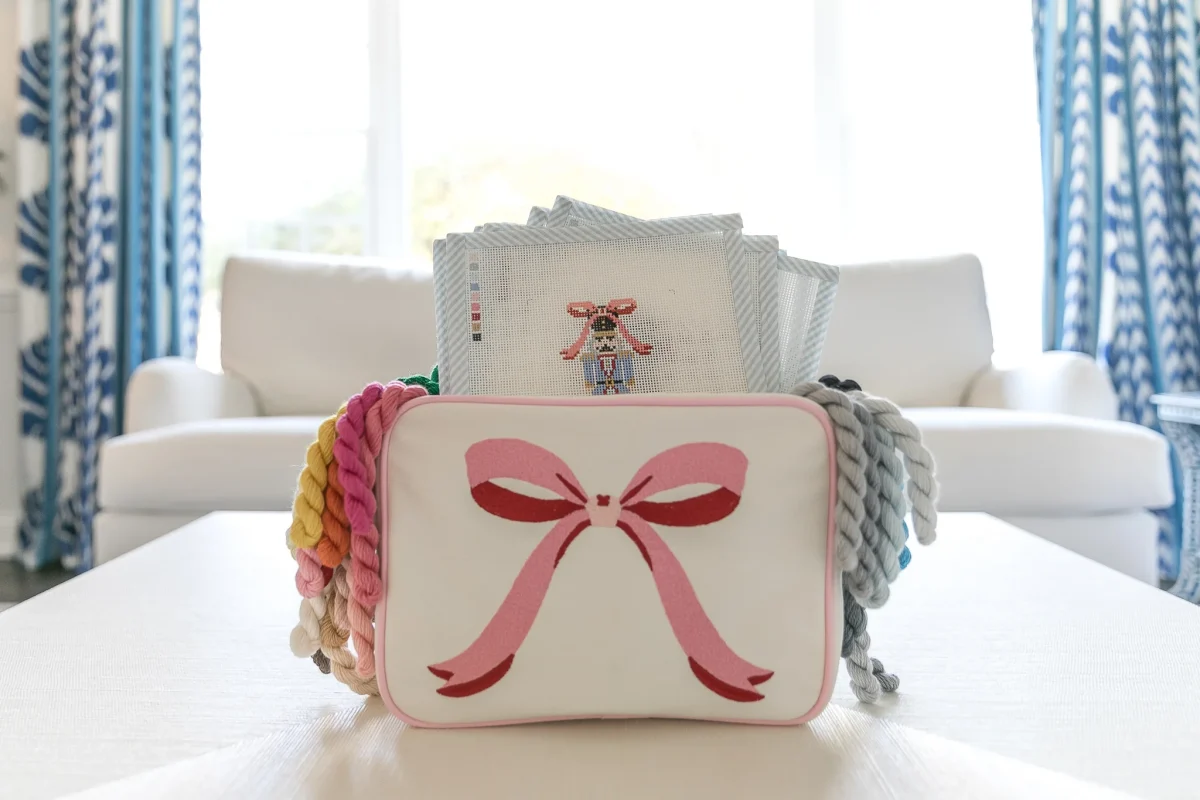
Taking note of the industry’s shortcomings, LeRay took it upon herself to create her own needlepoint brand, which, as it grew, would allow for the industry itself to grow as she introduced modernized designs to the needlepoint community, ranging from Taylor Swift lyrics to coastal lighthouses to martini glasses. However, it isn’t kitschy designs alone that have revived and advanced the craft, but also the expanded ways in which those designs can exist in the world. No longer are finished canvases destined to be made only into pillows or carpets, as was commonplace in the past, but rather, they can now be transformed into needlepoint belts, key fobs, bags, coasters, and countless other accessories that give needlepointers opportunities to display their hard work in functional and decorative ways.
Moreover, with a variety of different designs flooding the needlepoint market, one continuity seen across needlepoint creators is the ever-present New England aesthetic of designs. From picturesque sailboats to pastel hydrangeas to nautical flags, needlepoint is as much grounded in artistry as it is in the culture of the wealthy New England upper class. This luxurious, vocational aspect of the craft, reinforced by the small, nautical New England town aesthetic adopted by various stitching brands, gives needlepoint a personal and nostalgic quality that attracts even more to the art form. However, this upper-class illusion is not simply expressed through canvas designs, but rather it’s the unfortunate reality of the hobby as purchasing the materials for a single project often costs upwards of a hundred dollars. Therefore, needlepoint, for all of its redeemable qualities, can be enjoyed only by the few rather than the many.
However, even as the art form has become further modernized through such trends and aesthetics, the craft has remained rooted in tradition. Similar to stitchers today, needlepoint techniques were first employed by ancient Egyptians to depict religious and cultural images within tapestries or textiles. Later, during the Middle Ages, the process of needlepointing would be established, while the designs of the craft would develop during the Renaissance period, with geometric patterns and floral motifs becoming popular subjects for stitchers. Furthermore, as mirrored in today’s world of stitching, it was during the Victorian era that the craft became a symbol of refinement and domesticity, with finished pieces often being used to decorate homes in a personal way.
Evidently, despite the centuries of history the craft carries, the art form remains practically unchanged in its process and place in the world. Just as in the past, canvases are hand-painted to be hand-stitched and later hand-finished, often into ornaments, bags, and frames. Furthermore, needlepoint continues to force crafters to slow down and remain present in the moment, as, contrary to our digital world, needlepoint is unique in the fact that not only is it physically impossible to do while also scrolling on social media, but it typically takes days or weeks to complete a single canvas. Therefore, rather than providing instant gratification (the way scrolling through TikTok does), needlepointing allows one to appreciate the craft for its beauty as well as to truly experience the relaxation stitching provides.
Ironically, it is because needlepointing mandates this disconnect from constant digital stimulation that the art form has become a trend on TikTok, the very trap these crafters are attempting to escape from. Aside from the aesthetically pleasing canvases and meditative quality of stitching, new crafters have been drawn in by the community aspect of the art form. Stitch nights, classes, and even needlepoint weekend retreats have become commonplace within the needlepoint community, allowing stitchers to connect in a low-stakes environment while sharing a craft they are passionate about, a rare opportunity in today’s society. And all the while, crafters are creating a physical, tangible memory through their canvases that will last for years to come.
Needless to say, the needlepoint community is successfully bridging the gap between new and old, tradition and innovation, digital and tangible. In this way, needlepointing not only allows for the creation of unique, breathtakingly stitched pieces of art, but it also binds together generations of stitchers, culture, and lifelong friendships. Through needlepoint, the past is stitched into the present with the vibrant fibers of the future.